I thought it was funny at first, this guy mimicking my every move. He was one of those fake plant people that popped out of nowhere and he got the nervous laugh.
I smiled as I walked away, but he wouldn’t stop, imitating my every step and gesture, every facial expression, always staring back. I wanted him to stop. I told him that. And he said it right back.
“No, I mean it.”
“No, I mean it.”
“I’m not fucking Pee Wee Herman.”
That drew a gasp, especially when he repeated that.
I pushed him, which he did back, and came after me. And so I punched him good and made him hurt. I was the villain and accepted that happily.
The Sacred Whore is a dark comic thriller that digs into the chronic ills of our spastically contradictory world. We care. But we don’t. What better way to address that malaise than through shootouts, car chases and furiously sexy women?
Sean Baker’s magnificent Tangerine, his first film to focus on sex workers
It begins with a tractor-trailer trip across the country during which one of the sex workers, Corinne, assaults a would-be rapist, altering the direction of their journey. Some of the women – led by Ave and Dorothy – decide upon an outrageous plan to kidnap a college basketball team at the Final Four Tournament and demand primetime coverage to air their views on the moral destitution in America.
Others, led by Corinne, Chantal and Savannah, leave for Las Vegas where they confront JP, the queen-pin in charge of the sex trafficking network. The original group, now named The New World Brigade, dress up as cheerleaders and successfully hijack the college team bus. In Las Vegas, after maiming JP and executing her security team, Corinne is badly wounded by a police counter attack.
Chantal and Savannah find themselves in a hostage-taking situation and reach out to The New World Brigade, hoping to obtain leverage. After tense negotiations with the authorities, The New World Brigade returns with the team to the arena where each of the women post video statements on the travails of sex work. Chantal kidnaps a FBI agent, leading to a car chase in which she and Savannah are both killed. Stunned by this tragic turn of events, Ave delivers an emotional speech on live television, the final scene revealing Corinne opening her eyes to watch the broadcast from her hospital bed.
The Sacred Whore empowers and celebrates sex workers as complex individuals, rather than the tropes and cartoonish figures we have become accustomed to seeing. Outrageous truth drives the spectacle.
The pink pickup truck was just ahead, a car and then the truck. I saw it when we turned, better to the left. It got further ahead, and I tried to keep up. What was that voice yelling in my head? Was it a workman on the street? A bad childhood memory?
The pickup glowed in the evening light, like an artificial starfish, the driver waving her arms back and forth in a steady beat. No, that was a dog’s tail. The dog jumped into the front seat. I picked out our family dog when I was a kid. “Not afraid of that one!” That’s what I said.
I needed to see the driver. I knew it was someone I should know. I changed lanes and then back again. I met a beautiful girl in my Feminist Film Theory class. She had heard stories about me and she still liked me. She said that laughing. I really thought it would work out.
The truck caught the light, and I couldn’t keep up. I remembered missing the bus. Shadows glided past as I navigated the curbs. I couldn’t find my phone and then couldn’t get it to work. I thought about that familiar frustration as I watched her go.
Listening to Jafar Panahi speak about his filmIt Was Just An Accident made me think about my life, the things that I do, the things that I say I’ll do, my half-baked words and actions, the things that make me the regrettable quagmire of contradictions that I am.
I know one thing and one thing only: time passes. No matter the tastes and pains, the magic and nothingness-eses, that’s what it does. It passes.
I’m on the side of a narrow, cold channel. The lighthouse is in the distance. I take off my boots and socks and make my way across the kelp and rocks, expecting to fall, my body to wash out with the tide, found in the years to come, a human interest story on the northeast tip of Sanday Island in the Orkneys.
It is not as difficult as I imagine and brush the sand off my feet as I examine the small bird skull. The path winds beside a fallow field. The nettles are thick. I look back, wondering if the tide is already rising and I will be stuck here for the night. The lighthouse is fenced in and fully automated.
I return along the coast and am dive-bombed by oystercatchers. They screech and shit, and I scream back and throw rocks. They terrify me.
The tide rises, and I walk in the knee-deep water. There is an ancient tomb at the side of the road, but it has been covered over. Sheep stare back, their bodies oddly sheered and painted blue. I want to write, but I don’t know what about. Something true and real. Something fantastic and simple. Something about what I was doing here. Can oystercatchers be trained? And who will play me?
I had something in me that was real. I remember it. I don’t just remember it. I was wholly in that, everything raw and wild. That was when I was a kid, and I didn’t think about it like that. I was a kid and the world was open to anything I could imagine. I want to get back to that.
My head is old now. Experiences have eroded my wiring, bashed it about with learning to kowtow, inebriation and pretending to know. The desire is the thing, on tippy toes, to keep getting up like that. And I cannot.
It reminds me of a realization of love, that thing as it was at the outset, pure, the excitement, that anticipation, all of that wonder in the eyes, then realizing it was not magic, but a drug we’re self-prescribed. And now I can’t think of it as anything else.
The light from a childhood window, the smells from the hall, sounds of people downstairs, someone approaching, a mother, maybe not, knowing that space, looking back, realizing you are there, no one to answer to, just for the moment, in that world as long as you can make it, without closing your eyes, for as long possible.
If I die, then I die. The loss to this world won’t be great. I run through the memory of my past in its entirety and can’t help asking myself: Why have I lived? For what purpose was I born? There probably was one once, and I probably did have a lofty calling because I feel a boundless strength in my soul. But I didn’t divine this calling I was carried away with the bits of passion, empty and unrewarding.
My love never brought anyone happiness. I loved for myself, for my personal pleasure. And maybe I will die tomorrow. And not one being on this earth will have understood me totally. Some thought of me as worse, some as better, than I actually am. Some will say “he was a good fellow”, others will say I was a swine. Both one and the other will be wrong. (From Mikhail Lermontov’s A Hero of Our Time)
I’ve never understood how people know exactly who they are – not only the presentation of themselves but lying in bed with that awareness. I realize it is mostly a farce created to help us through birth to death, but I remain dumbfounded by their remarkable certainity in all of it.
My heads remains much the same as it was at Mia Frumhartz’s birthday party – I think it was her eighth – at the bowling alley where I decided to help her off with her coat. I didn’t know why I did that, aside from the fact that I like to be in the good graces of the fairer sex. I thought I would begin to know more about who I was as life went on. I was wrong.
My only consistent behavior has been to seek solitutude. The results are pending as is the impetus. In other words, I’m still just a kid trying to get away with stuff. My immediate desire when I have free time is to do things I’m not supposed to – smoke, drink, read trashy books – and get away with that as long as possible.
I do other things too, read stuff like Sartre, re-watch Tarkovsky films and have fine thoughts about important things. And I write too, my latest book focuses on an identity crisis, a person who revels in not only not knowing who he is but condemns those who pretend otherwise. And he blogs about that.
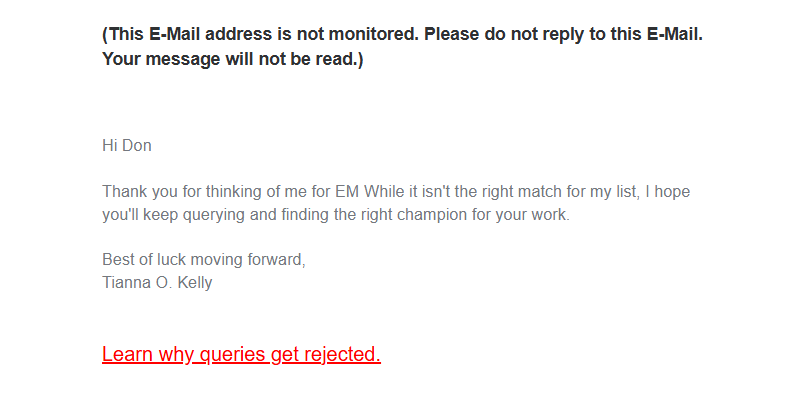
I have been sending out queries and writing samples to literary agents for many years and received the same form responses in a variety of phrasings: It’s not quite what I’m looking for at this time… I have to be particularly selective about which projects I represent…I can only responsibly take on a few new clients each year…I’m not the best fit for this project at this time… I’m not the best match…I’m not the right agent… I’m going to have to step aside…will be stepping back from consideration… I’ll be regretfully stepping aside.
Best wishes in your search for representation. Wishing you the very best of luck in your publishing endeavors. Please accept my very best wishes for your writing success. Best of luck with your future queries. I wish you the best of luck. I wish you all the best in your search for representation and in your writing career. We’re rooting for you! Until then, you have my…Very best.
Along with these snippets of clearly intended prose, the replies are sent from a “Do-Not-Reply-To-This-Email Address”. After 35 years, you’d think I’d get the message.
Contrasting the dim of the city against the icy wilds of Greenland, The Vanishing Pill exposes the violent inner conflicts of our nature. As McPhedran’s liner notes state: “Dreams aren’t simple things; they’re the only fucking thing.”
The advanced reviews are unanimous…
Atlantic Tri-Monthly: “I ate it up like a rabid monkey. McPhedran stews his prose with a burning hot sauce that leaves you screaming for more.”
USA Tomorrow: “You have not lived until you have read this intoxicating yarn of lust and joy.”
NY1 Off-line: “New Yorker McPhedran’s latest explosion of prose lights up the city with a tower of anguish and delight.”
Foxy News on-line: “It’s a good book, even with all the big words.”
I was genuinely excited to read Andy Weir’s highly-acclaimed Project Hail Mary, hoping for inspiration on improving the writing, structure and marketability of my own speculative work, The Cx Trilogy.
My positive outlook waned after a few pages. It wasn’t just the undeveloped writing nor the caricatured characters – much of which seem at first draft level – but more the lack of an engaging narrative. While the premise was compelling – why is the sun getting dimmer and how can this be stopped? – there was little development of the protagonist and his journey beyond a barrage of scientific details.
I’ll cite examples to mitigate your opinon of me as a bitter unpublished author. Below that is the room I woke up in. The one with my dead friends. I sniffle and wipe a tear away. Initially, I thought this was intended as sarcasm, but I soon realized that this was a genuine expression of Ryland Grace’s emotion.
Each of them kind of look like a beetle. Each beetle has a name up top: “John”, “Paul”, “George” and “Ringo”. I’m on a suicide mission. John, Paul, George and Ringo get to go home, but my long and winding road ends here. This sense of humor permeates the book.
My students didn’t swear at me. Their squabbles were usually resolved within a few minutes, either by a teacher-enforced handshake or detention. And somewhat selfish but here it is: They looked up to me. I missed that respect. Mr. Weir has clearly never spent a day as a teacher in his life.
I could go on, but why bury myself even deeper? Mr. Weir has achieved incredible commercial success and knows how to market his work, while I’m an unpublished failure who teaches high school…which is what makes this difficult to process.
I genuinely cannot understand what it is about Mr. Weir’s work that is compelling to such a large audience. And what it is about my own writing that seems destined to never get beyond the literary agent’s automatic reply: Unfortunately, your project does not sound like a fit for me at this time, and so I will have to pass. Boo hoo. Poor me.