Kafka told his publisher, Max Brod, to burn it all. Gogol actually went through with it himself. So did Bulgakov. The act of destruction that somehow…Somehow did what? How is that the next step? Is that it? Must I really? Throw everything to the wind? That’s the step that will get everything rolling?
Robert Downey Jr. chases down Michael Douglas’ opus in Hanson’s 2000 film Wonder Boys
The thing is that I’m too scared. Too simple a fellow. I cling to everything, the resarch and drafts, even the crap annotated by my profs, “What sophomoric crap!” I know it’s no good, that I need a flood or a fire to get this thing moving and get that punk of an agent to take notice.
That’s why I’m doing it, right? It’s all phony. I just have to announce it right, post it as a caption with the dead animals. That’s the breakthrough, the moment that I’m suddenly on tour recounting the moment as the silly anecdote it’s supposed to be. Wasn’t that crazy? What was I thinking? Where’s my lighter?
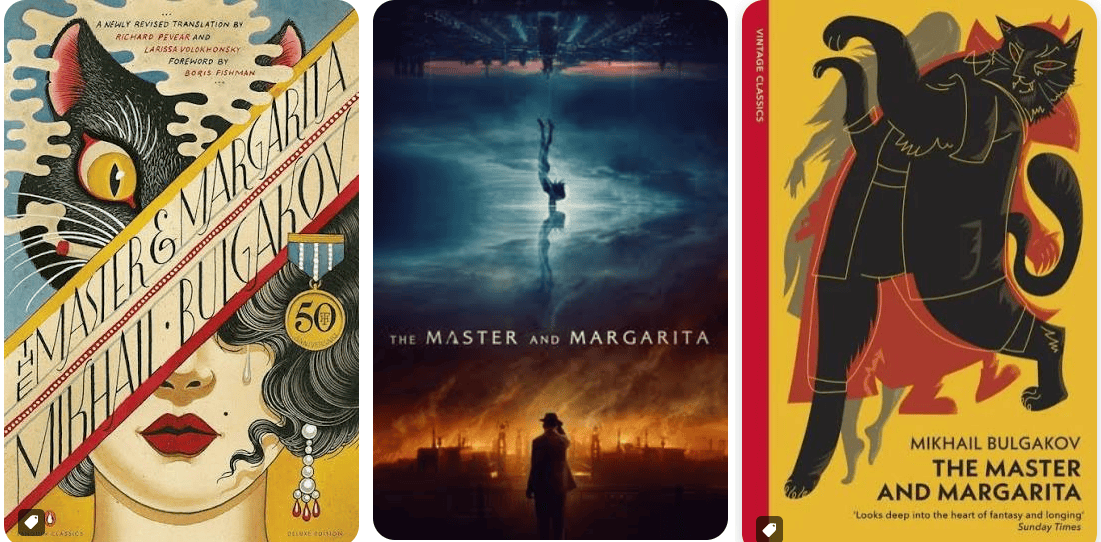
The accolades for Mikhail Bulgakov’s 1940 novel The Master and Margarita book are buoyant: “A 20th Century masterpiece!” “One of the greatest Russian novels!!” It is certainly wild and gripping at the start, a most unexpected and oddly humorous decapitation and talking cat setting the scene.
Here Ivan was struck by the conductress’s behavior. As soon as she saw the cat getting on the tram-car, she shouted with a malice that even made her shake, “No cats alllowed! Scat! Get off or I’ll call the police!” Neither the conductress nor the passengers were struck by the essence of the matter, not just that the cat was boarding a tram car, but that he was going to pay!
It is important to remember that the novel was written during the horrors of 1930’s Russia and Stalin’s death squads. But to read it for the story and art? There just isn’t enough to make it work. The narrative a ragtag outline, the dialogue wooden and the characters cartoonish, especially that of Satan (Woland), it is just confounding in the end.
The liquid, hot as lava, burned her hands, but Margarita, without wincing, and trying not to cause any pain, rubbed it into his knee. “My attendants insist it’s rheumatism,” Woland was saying, not taking his eyes off Margarita, “but I strongly suspect that this pain in my knee was left me as a souvenir by a charming witch with whom I was closely acquainted in the year 1571, on Mount Brocken, on the Devil’s Podium. Trifles! In another three hundred years it wll all go away!”
By the last hundred pages – especially in Bulgakov’s exhausting attempt to recreate the Faustian Walpurgis Night – it becomes an unending slog. While I did finish the book, I did not do it because I wanted to see how it turned out, but only to say, much like completing the same arduous task in reading the entirety of Herman Melville’s Moby Dick, “Yes, I had indeed read the book all the way through. Give me credit for that.”