Writing is all about the entry point, how to get to that nucleoid of inspiration. Is it a memory of being a wide-eyed kid, digging through the rotten green wooden box at the back of the garage? Flipping Ian Potter’s desk in History class after he smashed my plasticine Jaws Boat? Or crying, football helmet still on, when the final cuts were announced? Or the obnoxious young adult demanding white wine at a beer hall in Munich?
Wise thoughts under thick hair
Or is it the slipstream of dreams, late for the train, cutting around wheel chairs, finding a bathroom on a balcony, children hovering over a featherless parakeet, a tortured young woman pitching a documentary about first love, late for dinner with my dead parents who say nothing and leave before they pay the bill?
Beginning to feel regret
Or is it all high fallutin’, how we never got past the tragedies of the Greeks because whatever we’ve got, it’s just keys to a rental car, LPs in the trunk, everything achieved, everyone known, all that zippity nil, remembering those things, throwing up, waiting to die. Yeah, that’s probably the one.
I booked a ticket for an historic guided bicycle ride from Gdansk to Stuthoff for Saturday. The World War II museum emailed a confirmation date, but there was no time. I decided to drop by the museum to confirm.
“Excuse me.” I leaned down and spoke through the gap between the glass and the counter at the information booth. “Do you speak English?”
The young man narrowed his eyes. “Yes.”
“I want to confirm the time for the bicycle tour to Stuthoff.” I angled my phone screen towards him. “I have the date but I don’t know the time.”
“You need a ticket.”
“I have a ticket.” I pointed the screen more specifically in his direction. “It gives me the date but not the time.”
He peered briefly at the screen. “You need a ticket.”
Orson Welles’ adaptation of Kafka’s The Trial flashed through my mind.
I nodded at the phone. “I have a ticket. See?”
He pushed back his official museum cap. “You need a QR code.”
I showed him an enlarged screen. “I have a bar code.”
“You need a QR code.”
“Where do I get that?”
“You need to get a ticket.” He had a wispy mustache.
“But…” I peered at the screen again. “I have a ticket.”
“You need a QR code.”
“Okay.” I glanced around the empty space. “Is there someone else I could talk to?”
He pointed at the sign above the counter and back at himself. “Information.”
“I just need to know what time the bike tour is going.”
He stared back blankly. “You need a ticket.”
“You understand what I’m asking, right?”
“Yes.”
I decided to try one more time. “I have a ticket.”
“They must email you the ticket.”
“See? I have the bar code.”
“You need a QR code.”
“Okay, well…” I decided to try the ticket office downstairs where a thickly bearded man was putting away audio guides. “Excuse me?”
“Yes?” He was not interested in dealing with me.
“I want to confirm the time for the bicycle tour to Stuthoff.” I angled my phone screen towards him. “I have the date but I don’t know the time.”
He didn’t look up. “9:30.”
“9:30?”
“Yes, 9:30.” He continued to sort the guides.
“Thanks.” Unsure, I went outside and replied to the email, asking for a confirmation.
The answer came the next day. The bicycle tour leaves at 9:00. Arrive 15 minutes before that. Not 9:30. No QR code needed. 9:00. However I received an email a day later that the trip was cancelled. Heavy rain in the forcast. I would have to rebook at a later date.
Gunter Grass, the German/Polish 1999 Nobel Literary recipient and renowned author of novels such as The Tin Drum, The Flounder and Crabwalk, has been quietly cancelled.
This passively sinister action stems from a revelation that Grass had been drafted into the Nazi’s Waffen SS as a 16-year-old, something that he did not confess to until fifty years later in his 2003’s autobigraphy Peeling the Onion. I was silent. Because so many others have kept silent, the temptation is great…to shift the blame onto the collective guilt or talk about oneself only figuratively in the third person: He was, saw, did, said, he kept silent.
Gunter Grass statue in Gdansk is also shat upon
The common Polish thinking is that a tainted man such as Grass should not be granted the same esteem as fellow Nobel recipent Lech Walesa (and Gdansk native), who himself called Grass’ conscience into question. This cancellation stems not simply from a vague moral code but more so from how Mr. Grass wrote. As Jochen Bittner put it in his New York Times editorial: “There was a lot of self in his righteousness.” In other words, Mr. Bittner, like many others, felt that he was being written down to.
I remain a great admirer of Gunter Grass’ work, not only because of his literary talent and meticulous research but even more so exactly for the many characters who were forced to take responsibilty for their actions. Most poignant is a scene from The Tin Drum in which Alfred Matzerath chokes to death on his Nazi pin in an attempt to conceal his affiliation from the arriving Russian soldiers.
Grass’ cancellation echoes the 2018 attacks on Massachusett’s Senator Elizabeth Warren when it was revealed that she claimed Native Status on her application to Harvard, a trite notion championed by Donald Trump. The purpose of the accusation was not to achieve transparency, but rather to knock somebody who thought they knew better down to size, something the voting public took hook, line and sinker. This means that rather than have an astute, forthright and intently thoughtful leader in power, we are left with a yammering dolt who bullied, cheated and raped his way to the top.
What do we lose in this cancellation of Mr. Grass? In checking the books available at my local Gdansk library, a mere kilometer from his birthplace, I cannot find a single Grass title, but instead a ‘G’ section dominated by John Grisham and Tess Gerritsen, offering what appears to be the moral compass of the day.
As I’ve previously blogged, my move to Poland has distracted me from writing. I have more excuses too! I was in a work situation that was particularly draining. I’ve had to deal with being cancelled by family members. Not only that, I’ve had to settle the cats.
While I have been regularly submitting to literary agents – The Sacred Whore, Em & Baller – I’ve just as regularly been receiving the same auto-replies.
It’s time to get back to The Vanishing Pill, a book I’ve been working on for three years now. Or is it four? I’m some 3 3/8’s drafts in and still don’t know what’s to happen to Davis as he faces his private little wasteland. Is there a way to salvage his promise? Or is it just going to be all sad and pathetic?
Compelling and real, funny too, darkly so, all of that. But I have to get it it done! Words on the page. There’s nowhere to start but the opening: Davis twisted off the cap from his Paddy’s Old Irish Whiskey shooter and considered the prompt on the whiteboard. “What does it mean to be human?“
Monday was a big day. We were getting our PESEL numbers. Like the American Social Insurance Number, this opened the door to getting settled in Poland – bank account, phone, security check. We would start to feel like we had arrived. But before any of that, we had to get our crap out of the fridge.
Polish burauacracy dicates two medical clearances be taken for employment as educators – a throat examination and feces samples. I won’t go into the details – and avoid supporting imagery – but there were Q-tips and test tubes with fluid, three sets of each taken three nights in a row, each placed carefully in plastic baggies in the fridge.
It was impossible to avoid the surreptitious glance when opening the fridge door, the tubes in the baggies, then grabbing whatever quickly and getting it shut. It wasn’t the elephant in the room. We talked about it – always at meals – and meticulously prepared the necesary documents, triple-checking tram schedules, adding a note on the kitchen table “Remember Your Poop!” We arrived at the clinic well ahead of our appointed times. It was all very professional, passing the tubes over, and we were done.
The PESEL office was next, which was touch and go when the officer noted an electronic notatation that was not verified. Truth be told, she wasn’t pleased with us from the moment we arrived, asking if she spoke English. “This is Poland.” “We’re sorry but we only know Dziękuję (thank you) and piwo (beer).” On the verge of pushing our documents back at us, she paused and said that she would talk to her manager. I knew we would just have to come back. That’s how these things worked. It was just another step. Our shit was out of the fridge. At least there was that.
“I have good news for you.” She hung up the phone. “We will process you today.” She took our passports, wrote and stamped, printed and gave us the simple yet beautiful, pieces of paper, our numbers at the bottom. “This will open all of the doors for you.” We walked out into the glorious sun, strolled down the boulevard to the Lidl and lucked into pizza pastries fresh out of the oven.
The copy store was next, then T Mobile and ING, Marcin, our customer rep, sharing his thoughts on the misery of Polish history, a quick visit to the police department for an incomprehensibly stamped document, and then shopping – a blender, carpetted cat house and groceries to buy – and we were home. I glanced up as I opened the fridge. Yes. It was gone. We’d gotten our shit out.
I must admit to having lost my focus a couple of times early on in Miron Bialoszewski’s Memoir of the Warsaw Uprising. As I mentioned in my previous post, it’s a dense and repetitive narrative, and it can seem like nothing new is happening when of course the opposite is true. I had to go back and re-read to orient myself a couple of time, but one thing I couldn’t figure out was the meaning of the term “wardrobes”. Bialoszewski mentioned the it a couple of times, and I’d skimmed past it until I realized that I didn’t get it.
I looked back for the first mentions of “wardrobes” and couldn’t find them. I resisted doing a Google search but finally conceded: What do “wardrobes” mean in Miron Bialoszewki’s A Memoir of the Warsaw Uprising? The search results offered nothing accurate, I grudgingly resorted to an AI tool, which offered two options: First that wardrobes – the literal ones – were piled on the barricades and, second, that the term was used to describe people so badly burned as to be the color of a wardrobe. Neither was answer was relevant. This was his slang for being under attack. I looked back again and just couldn’t find it, until I carried on with my reading and finally found a reference that made it quite clear: At night, a breath of air. The moon. Shrapnel. “Wardrobes”. Exactly. Bomb-hurling wardrobes. (121)
In Bialszewski’s mind, the image of wardrobes perhaps softened the blow of what was happening or it was simply how he saw it. Indeed, what an image! Germans dropping furniture in a siege! Nevertheless, Google and AI didn’t understand it becasue the data was insuffcient.
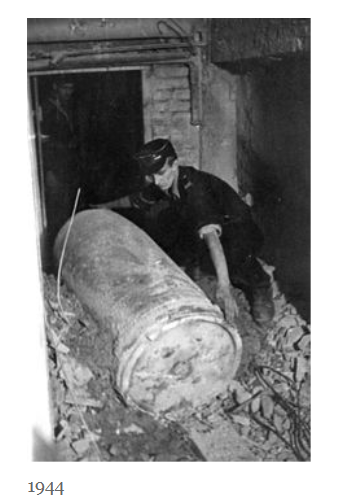
At 1700 today (August 1st), church bells and city sirens sound across Poland to commemorate the anniversary of the 1944 Warsaw Uprising, which resulted in the slaughtering of some 200,00 civilians and the annihilation of 85% of the city.
It was here that the uprising began to look as if it came out of a book. The kind about a siege. From the Middle Ages. And about an exotic, sweltering city. Where people start eating the bark from trees and the soles of their shoes. (33)
Miron Bialoszewski’s A Memoir of the Warsaw Uprising is a remarkable piece of writing not only for the mind-numbing content but also for the style, the use of repetition – “running’ appearing over 400 times – the matter-of-fact imagery and fragmentary sentences, conveying the terror and wonder of the moment.
It seemed as if we already had entire years of this behind us, and what was there ahead for us? There never had been, nor would there ever be, anything else, only the uprising. Which is to say it was impossible to endure much longer. Each day it was impossible to endure much longer. Then each night. Then every two hours. Then every fifteen minutes. Yes, People kept track of time incessantly. (51)
The facts of the conflict are not to be believed, all the more stunning when you understand that the Allies and Russians could have both come to the Poles aid and radically diminished the death and hardship, but for the politics of Stalin wanting to teach them a lesson, and the Allies not wanting to upset him.
All of a sudden – bombers. Already they’re hovering over the rooftops, raining down bombs. Now they’re gone. Now they’re back. Farther away. Closer. Now they’re flying into Baroque Street. We are too. They’re flying blindly. We are too. We is I. And someone else. Like me. We. Two of us. Here. Only. Neither here nor there. Because now. They’re here! We run. (72)
Politics and tragic history aside, I thought of teaching the book – the genius in the prose reflecting everyday life – but realized that the students would complain, “It’s so repetitious! He just runs around all over the place. It’s the same thing every day!” Which of course is the point. What else might there be in the end? Escape? Glory? Or just another day of the same? Which makes this a good day to remember that.
All of this is like one prolonged illusion. An awfully trite tale. But only this suits me. For what was felt then. Because you didn’t have to be a poet to have things multiplying in your head. (42)