
A.I. Needs My Help

I must admit to having lost my focus a couple of times early on in Miron Bialoszewski’s Memoir of the Warsaw Uprising. As I mentioned in my previous post, it’s a dense and repetitive narrative, and it can seem like nothing new is happening when of course the opposite is true. I had to go back and re-read to orient myself a couple of time, but one thing I couldn’t figure out was the meaning of the term “wardrobes”. Bialoszewski mentioned the it a couple of times, and I’d skimmed past it until I realized that I didn’t get it.

I looked back for the first mentions of “wardrobes” and couldn’t find them. I resisted doing a Google search but finally conceded: What do “wardrobes” mean in Miron Bialoszewki’s A Memoir of the Warsaw Uprising? The search results offered nothing accurate, I grudgingly resorted to an AI tool, which offered two options: First that wardrobes – the literal ones – were piled on the barricades and, second, that the term was used to describe people so badly burned as to be the color of a wardrobe. Neither was answer was relevant. This was his slang for being under attack. I looked back again and just couldn’t find it, until I carried on with my reading and finally found a reference that made it quite clear: At night, a breath of air. The moon. Shrapnel. “Wardrobes”. Exactly. Bomb-hurling wardrobes. (121)
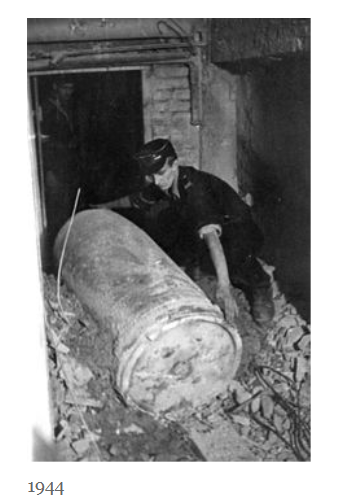
In Bialszewski’s mind, the image of wardrobes perhaps softened the blow of what was happening or it was simply how he saw it. Indeed, what an image! Germans dropping furniture in a siege! Nevertheless, Google and AI didn’t understand it becasue the data was insuffcient.

And so now I’m just feeding the machine.

Remembering the 1944 Warsaw Uprising

At 1700 today (August 1st), church bells and city sirens sound across Poland to commemorate the anniversary of the 1944 Warsaw Uprising, which resulted in the slaughtering of some 200,00 civilians and the annihilation of 85% of the city.

It was here that the uprising began to look as if it came out of a book. The kind about a siege. From the Middle Ages. And about an exotic, sweltering city. Where people start eating the bark from trees and the soles of their shoes. (33)

Miron Bialoszewski’s A Memoir of the Warsaw Uprising is a remarkable piece of writing not only for the mind-numbing content but also for the style, the use of repetition – “running’ appearing over 400 times – the matter-of-fact imagery and fragmentary sentences, conveying the terror and wonder of the moment.

It seemed as if we already had entire years of this behind us, and what was there ahead for us? There never had been, nor would there ever be, anything else, only the uprising. Which is to say it was impossible to endure much longer. Each day it was impossible to endure much longer. Then each night. Then every two hours. Then every fifteen minutes. Yes, People kept track of time incessantly. (51)

The facts of the conflict are not to be believed, all the more stunning when you understand that the Allies and Russians could have both come to the Poles aid and radically diminished the death and hardship, but for the politics of Stalin wanting to teach them a lesson, and the Allies not wanting to upset him.

All of a sudden – bombers. Already they’re hovering over the rooftops, raining down bombs. Now they’re gone. Now they’re back. Farther away. Closer. Now they’re flying into Baroque Street. We are too. They’re flying blindly. We are too. We is I. And someone else. Like me. We. Two of us. Here. Only. Neither here nor there. Because now. They’re here! We run. (72)

Politics and tragic history aside, I thought of teaching the book – the genius in the prose reflecting everyday life – but realized that the students would complain, “It’s so repetitious! He just runs around all over the place. It’s the same thing every day!” Which of course is the point. What else might there be in the end? Escape? Glory? Or just another day of the same? Which makes this a good day to remember that.

All of this is like one prolonged illusion. An awfully trite tale. But only this suits me. For what was felt then. Because you didn’t have to be a poet to have things multiplying in your head. (42)